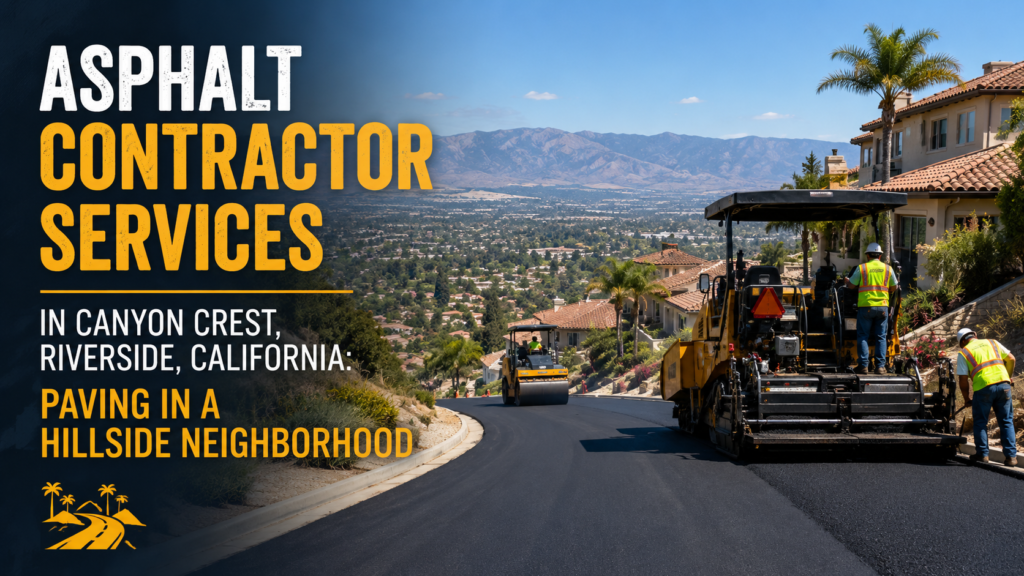
Canyon Crest is one of Riverside’s most distinctive neighborhoods a hillside community bounded by Sycamore Canyon Wilderness Park and developed across six separate land annexations between 1959 and 1986. Situated southeast of downtown Riverside at elevations up to 1,500 feet above sea level, Canyon Crest’s hilly terrain, mature landscaping, residential character, and proximity to the University of California Riverside create a specific context for asphalt paving services. Property owners in Canyon Crest from homeowners managing aging driveways on sloped lots to commercial operators maintaining the parking areas of the Canyon Crest Towne Centre require Asphalt Contractor Canyon Crest who understand Southern California’s climate, the specific challenges of hillside paving, and the soil conditions characteristic of this part of the Inland Empire.
Southern California’s Climate and Asphalt in Canyon Crest
Riverside sits in USDA hardiness zone 10a, with a climate defined by hot, dry summers and mild, wet winters. Average annual rainfall is approximately 10 to 12 inches, concentrated in the winter months. Summer temperatures regularly exceed 100 degrees Fahrenheit, while winter temperatures rarely drop below freezing. This climate creates a specific pattern of asphalt stress distinct from what Pennsylvania or Michigan property owners experience:
- UV oxidation: Riverside’s intense sun over 280 sunny days per year subjects asphalt surfaces to constant UV radiation. This oxidizes the asphalt binder, hardening it and causing surface cracking, raveling, and the characteristic gray color of aged asphalt. UV-related deterioration is the primary aging mechanism for asphalt in Canyon Crest, not freeze-thaw.
- Thermal cycling: Even without freeze-thaw, the daily temperature swings in Riverside warm days and cooler nights cause asphalt to expand and contract repeatedly over time, contributing to surface cracking.
- Summer softening: During the hottest periods, asphalt binder softens, making the surface susceptible to rutting under heavy vehicle loads, tire marks from stationary turning, and deformation at parking stops.
- Rainwater infiltration in winter: While infrequent, Riverside’s winter rains can be intense. Cracked asphalt surfaces allow water to infiltrate quickly to the base layer, and any standing water on the surface is a sign of drainage problems.
Canyon Crest’s Terrain and Paving Challenges
Canyon Crest’s hillside character creates paving challenges that distinguish it from Riverside’s flatter neighborhoods. The hilly terrain, developed on decomposed granite and rocky soils, affects nearly every aspect of asphalt paving:
- Slope drainage: Driveways on sloped Canyon Crest lots must be graded to direct water off the surface and away from structures without creating erosive flow on adjacent landscaping or neighboring properties.
- Sub-base conditions: Canyon Crest’s hillside soils described in landscape engineering literature as DG (decomposed granite) hillside soils can form an impermeable hardpan layer below the surface that inhibits drainage. This condition requires attention during base preparation for paving projects, potentially including perforated drain lines beneath the aggregate base to prevent water accumulation at the hardpan level.
- Slope stability: On steeper portions of Canyon Crest driveways, asphalt may be subject to creep slow downhill movement under vehicle loads and thermal cycling. Proper base compaction and appropriate asphalt mix design for the slope conditions mitigate this tendency.
- Equipment access: Tight lots, narrow streets, and steep grades in Canyon Crest can limit the size of paving equipment that can access some properties, requiring contractors experienced with working in hillside residential environments.
Residential Driveway Paving in Canyon Crest
Residential driveway paving is the most common asphalt service in Canyon Crest. The neighborhood’s homes predominantly single-story and multi-story houses on hillside lots feature driveways that range from short, gently sloped approaches to long, steeply graded drives that descend significantly from street to garage level. Each configuration presents different paving requirements.
For Canyon Crest driveways, quality installation involves:
- Assessment of existing conditions: Whether resurfacing or full replacement is appropriate depends on the base condition. In Southern California, where freeze-thaw damage is not a concern, well-constructed bases can remain sound for decades; the surface layer oxidizes and deteriorates while the base stays functional.
- Adequate base depth: Canyon Crest driveways should have a minimum 3 to 4 inch aggregate base (Class II base in California specifications) under the asphalt surface, with deeper base on slopes where drainage management is more critical.
- Appropriate asphalt mix: Southern California’s hot summers require an asphalt binder grade appropriate for the region’s temperature range. California’s strategic highway research program (Superpave) binder specifications for Riverside County are designed for the extreme summer temperatures of the Inland Empire.
- Surface sealing: In Canyon Crest’s UV-intensive environment, sealcoating every 2 to 3 years is important for maintaining asphalt quality and extending service life.
Commercial Asphalt Work at Canyon Crest Towne Centre
The Canyon Crest Towne Centre, the neighborhood’s primary commercial anchor, includes retail, dining, and service businesses that generate significant parking area maintenance needs. Commercial parking lots in Canyon Crest’s climate face the same UV and thermal cycling stresses as residential driveways but at larger scale and with heavier vehicle loads from delivery trucks and regular customer traffic.
Commercial asphalt maintenance for properties in Canyon Crest and near the Towne Centre typically includes periodic sealcoating and restriping programs, crack filling maintenance, pothole repair, and overlay resurfacing when the surface has deteriorated to the point where surface treatment alone is insufficient. ADA accessible parking requirements including proper slope, dimensions, and markings must be maintained through any resurfacing or restriping project.
Sealcoating: Essential Maintenance in Riverside’s Sun
In Canyon Crest’s high-UV environment, sealcoating is arguably the most important ongoing maintenance practice for asphalt surfaces. Sealcoating creates a protective barrier between the asphalt binder and the sun’s UV radiation, preventing the oxidation that causes binder hardening, surface cracking, and raveling. In Riverside’s climate, skipping sealcoating can accelerate visible deterioration by years, moving a surface from excellent condition to cracked and gray within a handful of seasons.
Sealcoating should be applied to new Canyon Crest asphalt 6 to 12 months after installation and every 2 to 3 years thereafter. In Southern California’s year-round warm climate, the application window is essentially continuous temperatures are rarely below the 50-degree threshold required for proper sealcoat curing, although applications should avoid wet conditions and extremely hot summer days when the sealant dries too quickly to penetrate the surface properly.
Conclusion
Asphalt contractors in Canyon Crest work in a neighborhood where the combination of hillside terrain, Southern California’s UV-intensive climate, and the specific soil conditions of decomposed granite hillside development all shape what quality paving involves. Property owners in Canyon Crest who understand these factors and who work with asphalt contractors experienced in Inland Empire hillside residential work invest in pavement that performs reliably in one of California’s most characterful and climatically demanding suburban environments.